
Joining the workforce right after college is a huge transition. Sharing some habits that help build a professional environment.
Many careers are affected by small workplace pitfalls that people fail to notice early.
Pitfalls usually begin as tiny habits, small misunderstandings, rushed reactions, or avoidable assumptions. When ignored for too long, they slowly grow into another dangerous “P” in workplaces – Politics.
Office politics means in simple terms – people losing trust, unclear communication, teams forming sides, or unnecessary tension spreading quietly. Many workplace pitfalls can be foreseen and prevented by trainees.
1. The “Reply-All” Pitfall
A trainee once became frustrated after receiving repeated corrections from a senior employee. Wanting to defend themselves quickly, they sent a long emotional email and accidentally copied the entire project team. While the issue itself was small, the chain reaction that followed stretched fueled it as a huge issue. For months afterward, coworkers became cautious around this trainee and the senior employee, because they were seen as reactive under pressure. Every new person who joined the team was given instructions to deal with them with utmost caution.
Could it have been prevented? As not every frustration deserves an immediate response. Try to clarify privately first and avoid public defensiveness.
2. The “Over-Sharing” Pitfall
A new trainee wanted to fit in quickly. During lunch breaks, they listened to coworkers gossip about managers and team decisions. Slowly, they joined the conversations too. One day, a casual remark they made traveled back to leadership. Suddenly, they were viewed as impudent & someone who could not be trusted with discretion. Listening to gossip is risky. Participating in it is riskier.
It is important the differentiate between networking and gossiping. Spilling the tea works in student circles, but at work, it feeds into office politics. Maintain professional ethics and do not discuss confidential conversations or feed into negativity. Have the courage to avoid conversations that tear down people.
3. The “Invisible Work” Pitfall
A hardworking intern quietly completed tasks every day but never communicated progress, blockers, or achievements. Another trainee with average technical skills regularly updated managers clearly and professionally. At evaluation time, managers remembered the visible communicator more. The quiet trainee felt overlooked and blamed “office politics.”
In reality, part of the issue was visibility. Good work should not become invisible work. Silence hides your effort from the people who matter.
4. The “Choosing Sides” Pitfall
In one office, two senior employees disagreed often. A trainee unknowingly began aligning strongly with one side, laughing at jokes, agreeing publicly, avoiding the other group. When project leadership changed months later, relationships became uncomfortable very quickly.
Trainees should build bridges, not camps. Never take sides. Stay respectful and avoid unnecessary alliances. Maintain professional neutrality. Remember, professionalism survives leadership changes.
How Trainees Can Foresee Pitfalls Early?
- Watch for Patterns – If the same confusion, tension, or complaint appears repeatedly, pay attention.
- Observe Before Reacting – Spend your time learning about the workplace culture and do not share your opinions with others. Share facts, not opinions.
- Protect Your Reputation – Look for ways to build a positive reputation and protect it
- Don’t Feed Drama – Remember, not every conversation needs your opinion.
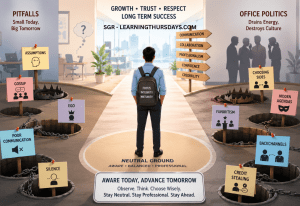
When Pitfalls Become Politics
Office politics often grows when communication breaks down, emotions replace professionalism, people seek attention over teamwork and/or trust disappears.
You may not always be able to control workplace politics, but you can ALWAYS control whether you contribute to it. The most respected trainees are usually the ones who stay neutral, communicate professionally and avoid unnecessary conflict.
While every workplace has pitfalls, the goal is not to become fearful. The goal is to become aware as it helps build stronger relationships, avoid conflicts and protect potential opportunities for growth.