
Joining the workforce right after college is a huge transition. Sharing that some habits that help build a professional environment.
When a trainee walks into a new workplace for the first time, everything feels bigger than it really is—the systems, the expectations, the pace, even the unspoken rules. It’s easy to feel like you need to “figure it all out” at once. That’s where many people stumble. They face challenges because they aim too broadly, too quickly.
Goals, when approached the right way, act less like pressure and more like anchors.
Early in my career, I watched a new hire sit quietly in meetings takes notes but did not contribute. When asked why, her response was that she wanted to absorb everything before understanding what and how to contribute. While it sounded responsible, a little nudge from her manager got her to start thinking how she would contribute in the meetings. Everyone was asked to share progress on their activities. That shift from overwhelming ambition to manageable progress is what makes goals powerful.
Small, accomplishable goals create momentum. They give structure to uncertainty. Instead of thinking, “I need to become excellent at this job,” it becomes, “Today, I’ll learn how this tool works,” or “This week, I’ll improve how I communicate updates.” These are goals you can act on immediately, without waiting to feel fully ready.
There’s also something transformative about achieving small goals. Each one builds confidence. Each one turns a new environment into a familiar one. Over time, those small wins compound into competence.
Setting goals matters as much as how you approach to accomplish them.
The trainees who grow fastest aren’t the ones chasing perfection. They are the ones who stay consistent. They reflect periodically: Did I understand what I worked on today? Did I ask for clarity where I needed it? Did I improve, even slightly, from yesterday? They treat learning as an ongoing process rather than a one-time milestone.
Another trainee I once knew created a simple ritual at the end of each day. She would write down three things: what she learned, where she struggled, and what she would do differently tomorrow. It took her less than ten minutes, but it sharpened her focus. Instead of drifting through tasks, she was intentionally building skills. Months later, her growth wasn’t accidental—it was the result of deliberate, goal-driven reflection.
It’s also important to recognize that goals aren’t meant to isolate you. In a workplace, progress often comes faster when you involve others. Asking a colleague for guidance, observing how someone experienced approaches a task, or requesting feedback on your work, all these are ways to accelerate your learning curve. Goals become more achievable when they are connected to real interactions and shared knowledge.
And then there’s the quiet challenge many trainees face but rarely admit: the fear of falling behind. When you look around and see others moving confidently, it’s tempting to believe you’re the only one still figuring things out. That’s rarely true. Everyone starts somewhere, and everyone builds their rhythm over time. Setting small, realistic goals keeps you grounded in your own progress rather than comparing it to someone else’s pace.
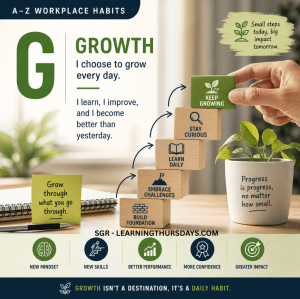
Growth in a new organization isn’t about making one big leap. It’s about taking steady, thoughtful steps. It’s about showing up each day with a clear, simple intention—learn this, improve that, try again.
In essence, goals aren’t just targets to hit. View them as tools to shape who you become at work, someone who learns continuously, adapts confidently, and grows with purpose & that’s a habit worth building early.
Growth begins when you stay grounded and are willing to keep going!
Tomorrow, we will focus on H – Habits!