
In continuation of last week’s article on Triveni Sangamam, today will share how Ganga descended on earth!
Long ago, in ancient India, there lived a great king named Sagara, who ruled with wisdom and strength. He performed a Aswamedha yagam (sacrifice). Just as the final ritual was about to be completed, the sacred horse meant for the ceremony disappeared. Furious, the king sent his sixty thousand sons to find it.
The princes searched far and wide. They finally found the horse deep underground. It was beside the sage Kapila, who sat in meditation. Mistaking the silent sage for a thief, they shouted angrily and tried to seize the horse. When their noise disturbed his penance, the sage opened his eyes. With the fire of his gaze, all sixty thousand princes were reduced to ashes.
Time passed. The souls of the princes were trapped between worlds — unliberated and restless. Centuries later, King Sagara’s descendant, Bhagiratha, learned of their fate and vowed to free them. The sage told him that the waters of the heavenly river Ganga only can purify their souls.
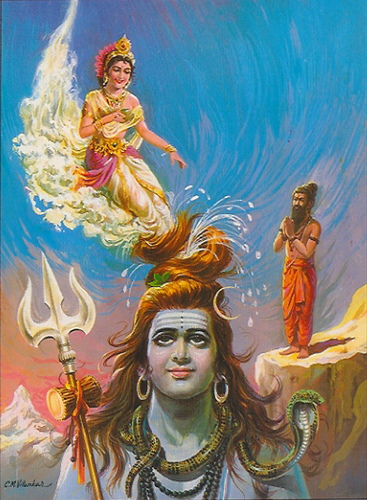
Determined, Bhagiratha performed austerities for thousands of years. Goddess Ganga was moved by his devotion. She agreed to descend to Earth. However, she warned that her mighty flow would shatter the planet. So Bhagiratha prayed to Lord Shiva, who promised to bear her descent in his matted hair.
Ganga finally poured from the heavens. Shiva caught her in his locks. He gently released her in silvery streams that danced across the mountains. These streams became the river Ganga. Flowing through forests, valleys, and villages, she followed Bhagiratha’s lead until she reached the ashes of his ancestors. With her touch, their souls were freed and ascended to the heavens.
From that day, the Ganga became a symbol of purity, redemption, and eternal compassion. Her waters are said to wash away sins.
Bhagiratha was thus able to bring down the river Ganga and liberate his ancestors. This task had been passed down for five generations.