
Long ago, in a small village nestled near the river Ganga, there lived a humble bangle seller named Haran.
Every morning, he would walk through the lanes calling out, “Bangles! Bangles of every color—red for brides, green for prosperity, yellow for joy!” His bangles brought cheer to women of the village, yet Haran himself struggled to make ends meet.
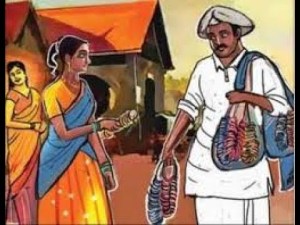
One fall, during the days of Navaratri, Haran had hardly sold any bangles. On the last day, dusk settled. He sat under a banyan tree and folded his hands in prayer. “O Mother Durga, You protect us all. Today I have nothing to take home. Please bless me with a little hope.”
That night, Haran dreamt of a radiant woman draped in red, her eyes deep as the universe. She smiled and said, “Bring your bangles to my temple tomorrow. I shall wear them.”
When Haran awoke, his heart was pounding. He wasn’t sure if it was real. Nevertheless, he gathered his best glass bangles—red, green, and gold-flecked. He carried them to the village temple where the idol of Durga stood in all her glory. He left them near Her feet and bowed.
The next morning, when the priests opened the temple, they found something astonishing. The idol of Goddess Durga was adorned with delicate bangles, glittering in the early light. No one knew how they had slipped onto Her divine hands. The villagers rejoiced, declaring it a miracle, and they honored Haran for his devotion. From that day forward, Haran’s fortunes changed—his bangles were sought after not just as ornaments, but as sacred offerings.
Even today, in many Durga temples, women offer red and green glass bangles to the Goddess. They believe that She blesses their families with protection, harmony, and prosperity. During the final immersion of Durga Puja, many married women place bangles on Her hands. This act is a symbol of their love and devotion. They remember the story of Haran. The Mother accepts even the simplest gifts given with faith.