
In India, the harvest festival is celebrated in the middle of January (13, 14, 15, 16). Each of the days is celebrated for different reasons. It is interesting how small cultural acts significantly impact the community. They greatly influence our lifestyles!
The festivals are called by different names but celebrated with similar enthusiasm and rigor across the country!

Understanding the reason behind the festivals helps in following the same in spirit, passing it down the across generations!
Jan 13th – Bhogi Lohri
This festival is celebrated to learn to let go. It helps us burn away our bad habits, old things, and unused items at home. It encourages us to de-clutter both our mind and home.


What is usually put in the fire? Once a year, a de-cluttering activity is taken up at the onset of the year. Old clothes, old and torn bed sheets, and run down mats and mattresses are discarded. Broken stuff around the house is also included. Cardboard boxes and sacks that used to hold rice and grain earlier are added too. All these items are usually put in the fire.
One of my colleagues developed a smoke pollution meter. It measures how long the smoke lasts. It lasts for about 4-5 hours. After this period, the city smoke and pollution levels get back to a normal state.
This is one of the BEST ways I have seen to de-clutter the house. Anything that can be donated to other family members or relatives is kept aside. Items that can be given to help staff are also set apart. Items that are run down are burnt away. Avoids moving the pile of stuff from one place to another around the house constantly.
Jan 14th – Pongal / Makar Sankranthi
This festival is best seen celebrated in villages or near temples. Women light up the fire and put earthen pots on it filled with water, rice, and lentils. They cook them in the open air. This dish and festival are called Pongal. The freshly harvested rice and lentils are cooked for the first time. They are offered to God. Then, they are eaten as prasad (holy offering).


The right side picture is when the mixture in the pot starts to boil over – representing abundance! Communities shout “Pongal-O-Pongal” and celebrate it with pomp and show!
Seeking blessings from parents and relatives and elderly is very common on this day! Along with blessings, children get new clothes, newly-wed couple get new clothes and gold jewelry, and festivity fills the air.
In some cultures, small dolls are made to celebrate the occasion. Sankranthi kolu, an arrangement of dolls, is also done to celebrate the occasion!

Huge rangoli (Kolam) patterns are made with rice flour in front of the entrance of homes. They are colored and decorated with flowers. In some places, they are adorned with cow dung (to ward off the evil eye). Competitions are conducted in the neighborhoods to sustain the sense of community.

Jan 15th Maattu Pongal (a.k.a Kanu)
This festival is celebrated to thank the birds and animals around us. Different cultures have specific rituals to celebrate for cows, crows, birds and different animals.


One ritual specifically about feeding birds (the on the leaf above) is interesting!
Sisters and their children and in-laws come together and perform this festival. There is a poem recited during the gathering. It makes me feel that the conversation is carried forward through the crows and birds. This becomes intangible memories passed to the next generation. Various types of mixed rice are prepared on that day. They are served to all relatives. Everyone eats together after the birds finish eating.
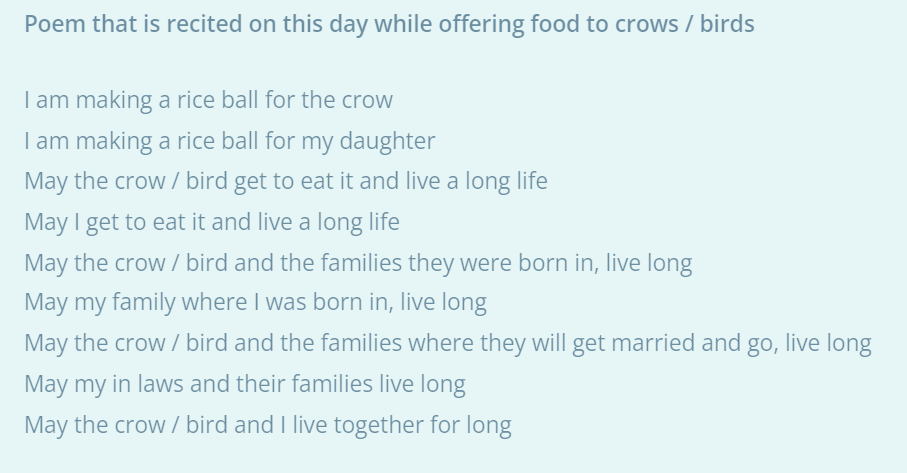
The thought behind living in harmony with other species is inspiring. Considering the welfare of our homes in conjunction with birds and animals shows a deep sense of community. This attitude towards togetherness can last across generations!
Sarvo jana sukhinobhavantu
Reading this article – a friend shared this version of the song (realized there are many versions of the poems.. essence seems to be the same though)

Jan 16th Kaanum Pongal
Mostly in North India, the celebrations are for 3 days. In Tamil Nadu, the fourth day is dedicated to meeting friends and relatives. Usually no one stays at home that day and everyone tries to spend some time outside. Visit relatives and grandparents. Explore local fairs in the city or relax at the beaches. Spend time with friends and families outside of home. It is like a day-off from celebrations and cooking for women at home.
It is believed that when one celebrates a festival and gets blessings from elders, one bad omen in their life can be avoided!
Wishing you happiness and abundance of prosperity during the festive season!